Health and Safety Policy — Flat Clearance Kingston upon Thames
 This Health and Safety policy sets out the principles and procedures that govern safe operation for flat clearance and waste removal activities undertaken by our team. The aim is to protect employees, residents, visitors and contractors during flat clearances across our rubbish company service area. The policy addresses risk assessment, training, equipment maintenance and incident reporting, and it applies to all stages of a clearance from initial survey through to final disposal. Safety is integral to every job and is a condition of employment and engagement for any subcontractor.
We outline the scope and responsibilities below to ensure consistent compliance with health and safety obligations for any flat clearance service. Our approach emphasises prevention, minimising manual handling risks, and reducing environmental hazards associated with waste collection. All staff must follow safe systems of work and report hazards immediately. Supervisors will monitor adherence and take corrective action where necessary.
 Policy scope includes domestic and commercial flat clearance, furniture removal, bulky waste handling and small-scale rubbish removal projects. The policy covers interaction with residents, safe access and egress in communal buildings, secure storage of tools, and management of hazardous items. Where specialist removal of hazardous waste is suspected, work will be halted until qualified contractors are engaged. Employees must not attempt to move unknown hazardous materials.
Key Responsibilities
Management responsibilities include ensuring adequate resources for training, personal protective equipment (PPE) provision, vehicle maintenance and safe handling tools. Managers must carry out and document risk assessments for each clearance site, schedule regular safety audits and ensure all operatives hold relevant competency records. Clear lines of authority will be maintained so that any safety concern can be escalated and resolved without delay.
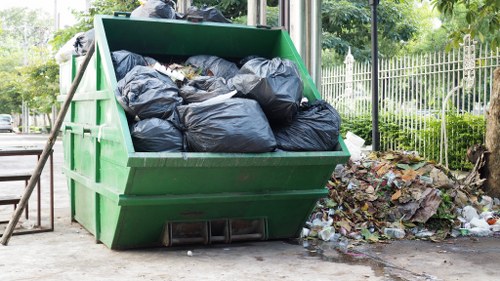 Worker responsibilities are to follow instructions, use PPE correctly, complete mandatory training modules on manual handling, and report near misses. Staff must conduct a dynamic risk assessment at the start of each task and be empowered to stop work if an immediate danger is identified. Team communication and supervision are essential when navigating stairways, lifts and narrow corridors during waste removal.
Contractors and temporary staff must comply with this policy and demonstrate competency before site work begins. The company maintains a permit-to-work process for complex clearances and requires proof of training and insurance from third-party providers. Failure to comply may result in removal from the project and review of contract terms.
Risk Management and Safe Working Procedures
Risk assessments will identify common hazards: manual handling injuries, slips, trips and falls, traffic and vehicle risks, sharps and biohazard exposure, asbestos suspicion, and fire risks. Control measures include mechanical aids, two-person lifts for heavy items, secure walkways, adequate lighting and housekeeping standards. Regular toolbox talks reinforce these measures before starting jobs.
Our safe working procedures mandate the use of appropriate PPE — gloves, high-visibility clothing, steel-toe boots and respirators where dust or allergens are present. A clear waste segregation protocol reduces contamination risks and supports safe transfer to authorised disposal facilities. The policy also emphasises correct loading practices to prevent vehicle instability and roadside hazards during rubbish collection operations.
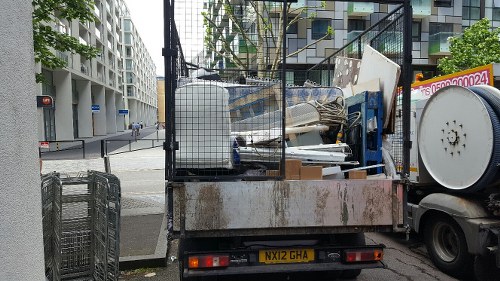 Emergency procedures include first-aid provision, incident reporting, and swift liaison with emergency services when required. All incidents are recorded, investigated and reviewed to prevent recurrence, and corrective actions are tracked to completion. Employees will be supported during investigations and brought up to date on lessons learned.
 Training, monitoring and continuous improvement are central to the policy. Induction training covers the basics of flat clearance, manual handling, waste classification, and infection control. Ongoing competence checks, refresher courses and supervisors’ assessments help maintain standards. Performance metrics, such as incident rates and audit outcomes, are reported to senior management for review.
Health and wellbeing are also recognised: staff are offered guidance on fatigue management, safe driving practices and access to occupational health where needed. Mental health awareness forms part of the training schedule, reinforcing a supportive working environment during potentially stressful clearances.
Compliance with this Health and Safety policy is mandatory. The policy will be reviewed annually or when operational changes occur. Stakeholders across the waste removal and clearance teams are encouraged to contribute to continuous improvement. This document provides the framework for safe flat clearance operations and aligns with statutory duties while reflecting practical measures for efficient, safe rubbish removal across the service area.